Guide your reader—one click at a time.
When you design a multi-page PDF—whether it’s a digital report, catalog, portfolio, or interactive guide—it’s not just about the visuals. It’s about navigation. A smooth user experience starts with clickable buttons, links, and bookmarks that help readers jump between sections effortlessly.
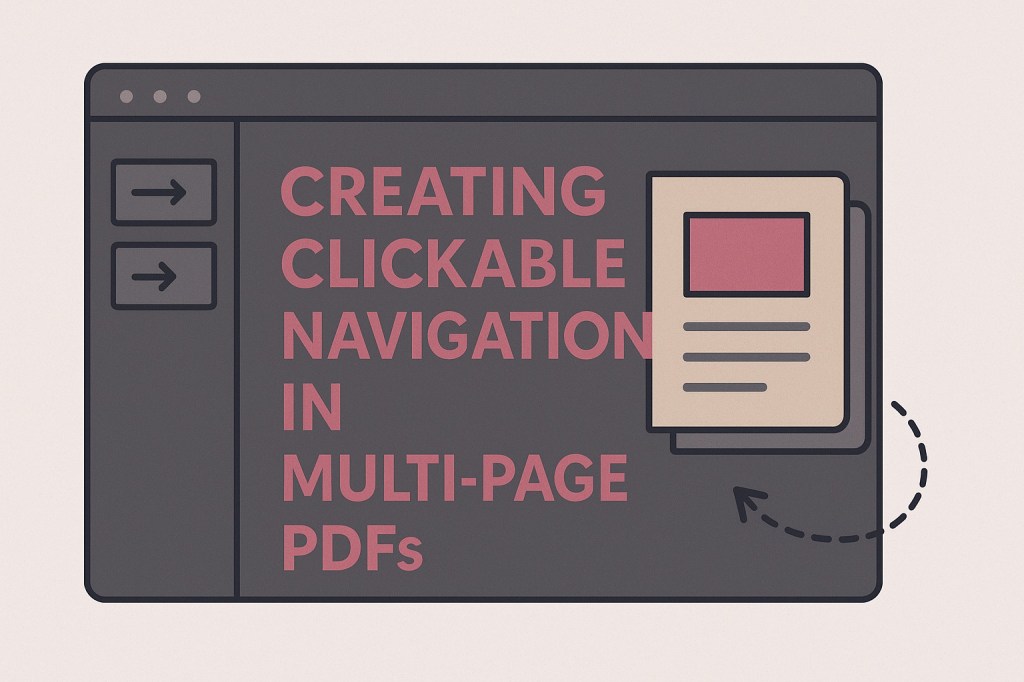
Adobe InDesign makes this easy with built-in tools for creating internal links and interactive navigation. Here’s how to turn your multi-page PDF into a guided experience.
🔗 Step 1: Use Consistent Page Layouts and Styles
Before adding navigation:
- Divide your content into clear sections (e.g., Intro, Chapter 1, Gallery, Contact)
- Use master pages to include headers/footers across pages
- Create character styles or object styles for nav buttons and links
- Label sections visually so they’re easy to link to
Think in terms of usability: What will your reader want to jump to?
📍 Step 2: Create Text Anchors or Page Destinations
To jump to a specific location in the PDF:
- Place your cursor where the section starts
- Go to Window > Interactive > Hyperlinks
- From the panel menu (☰), select New Hyperlink Destination
- Choose:
- Page to link to an entire page
- Text Anchor for precise navigation
- Name the destination (e.g., “Chapter2_Start”)
Repeat for all major navigation points.
🧭 Step 3: Build Your Navigation Menu
Create a navigation bar or table of contents using:
- Text (e.g., “Go to Gallery”)
- Icons or buttons
- Footer or sidebar navigation elements
To make it clickable:
- Select the text or object
- In the Hyperlinks panel, click New Hyperlink
- Link to: Text Anchor or Page Number
- Choose appearance settings (visible/hidden link styling)
You can also assign actions like “Go to Page” via Buttons and Forms.
🔘 Step 4: Add Buttons with Actions
To create interactive buttons:
- Draw a shape (rectangle, arrow, icon)
- Open Window > Interactive > Buttons and Forms
- Set Type to Button
- Add Action:
- Go to Next Page
- Go to Previous Page
- Go to Page X
- Go to URL (for external links)
Name your button clearly so it’s easy to manage.
📄 Step 5: Export as Interactive PDF
To retain clickable navigation:
- File > Export
- Format: Adobe PDF (Interactive)
- In the dialog:
- Enable Include All Interactive Elements
- Set Initial View to Fit Page or Fit Width
- Optionally check Open in Full Screen Mode (good for presentations)
Click Export. Open in Adobe Acrobat or Reader to test your nav system.
🧠 Pro Tips
- Keep navigation consistent across pages (use masters)
- Use icons (home, back, arrows) for intuitive clicks
- Add a “Back to Top” button on long pages
- Test on different devices for usability
- Don’t forget accessibility—make sure buttons have clear labels or tooltips
✅ Use Cases for Clickable Navigation
- Interactive company reports
- Portfolios or case studies
- Course guides or workbooks
- Interactive eBooks or manuals
- Product catalogs
📘 Final Thought
Clickable navigation turns your PDF from a flat document into an engaging user experience. Whether you’re guiding clients through a pitch deck or leading students through a workbook, navigation makes it intuitive, fast, and user-friendly.
Design the journey—not just the destination.